The 6-6-6 Walking Challenge: Does It Actually Work?
Six days a week, six weeks, and either 6,000 steps or a 72-minute walk. Here's what the viral 6-6-6 challenge really asks of you.


My neighbor showed me her phone on a Tuesday morning, mid loop around the block, still in her slippers. Day nine of the 6-6-6 walking challenge, she said, six thousand steps and counting. She looked proud and a little wiped out at the same time, which pretty much sums up why this thing is suddenly everywhere.
If you have scrolled past someone doing "the 6-6-6" on a treadmill or a neighborhood loop, you have seen the trend. Search interest in walking challenges jumped more than 2,400 percent over the past year, and 6-6-6 sits near the top of that spike. It is simple enough to explain in one sentence, and vague enough that half the people trying it are not doing the same version.
What the 6-6-6 challenge actually asks of you
There are two versions going around online, and mixing them up is the fastest way to feel like you failed a challenge you never actually agreed to.
- Version one: walk six days a week, hit at least 6,000 steps each day, for six weeks.
- Version two: walk 60 minutes with a 6-minute warmup and a 6-minute cooldown, done around 6am or 6pm, six days a week.
Both share the same backbone: six days, six weeks, and a rule of six that removes the guesswork about what counts as enough. Version one is closer to a daily step habit. Version two is closer to a full hour-long workout, six days a week, which adds up to 360 minutes of walking. That is more than double the standard 150 minutes a week activity guideline.
Why it blew up this year
Coverage in outlets like TODAY and Health, plus a wave of TikTok posts, pushed 6-6-6 from a regional trend into a global one in a few months. People tracking fitness content online point to the same reason 12-3-30 and Japanese interval walking took off before it: no ambiguity. You either hit 6,000 steps or you did not. You either walked the hour or you did not. There is nothing left to interpret.
Does it actually work, or is it just a lot of walking
One writer at Health tried the 60-minute version for a full month and came away with better endurance and a noticeably better mood, but admitted an hour of brisk walking six days a week left almost no room for anything else, including strength training. That is the honest tradeoff. The 6-6-6 challenge is not magic, it is volume. If your current baseline is a desk job and a short commute, jumping straight to six hours of walking a week is a big ask. If you are already walking most days, it is a reasonable structure to build toward more.
Physical therapists and trainers who have weighed in generally agree on one thing that matters more than the exact numbers: consistency. Missing the 60-minute mark on a rough Thursday does not undo four good days before it. If 6,000 steps sounds low next to the old 10,000 benchmark, we broke down why that number was never required in the first place and what the research actually supports.
How to try it without quitting in week two
- Start with the 6,000-step version if 60 minutes feels like too much right away. You can always add time later.
- Split long walks if your day does not have one free hour. A 30-minute walk at 6am and another at 6pm still add up to the same total.
- Take the rest day without guilt. It is built into the plan, not a cheat day.
- Write the six weeks down somewhere you will actually see it: a calendar, a note, or a streak counter.
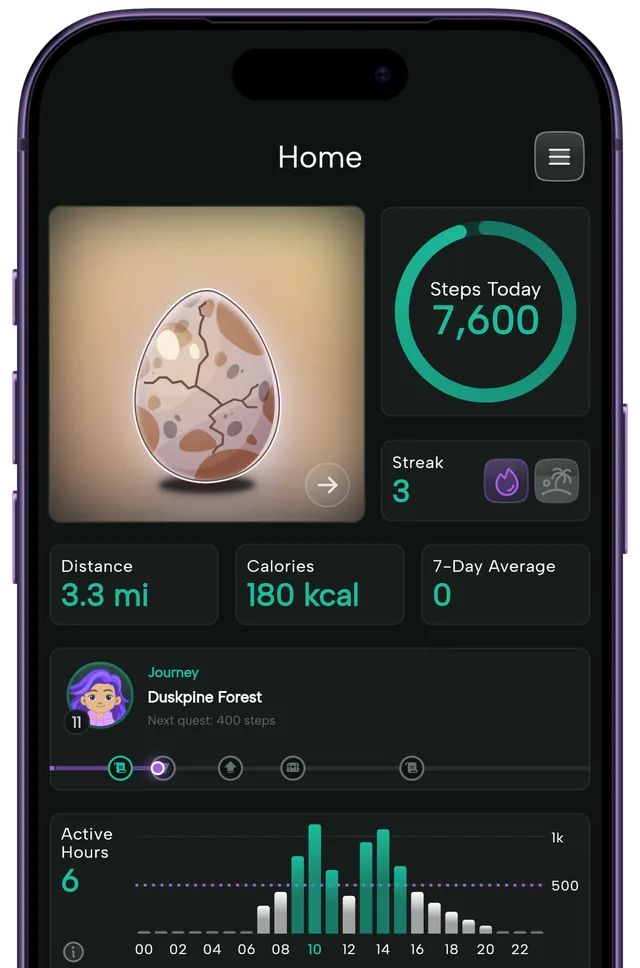
That last one is where an app like Steps & Beasts earns its keep. Six weeks is close to how long it takes to hatch a few eggs if you walk most days, and watching a beast grow alongside your streak gives you something to check on besides a step total. It does not punish a missed day the way a blank calendar square does.
Quick answers about the 6-6-6 challenge
Is 6,000 steps a day actually enough? For most adults, yes. Benefits from walking tend to plateau well before 10,000 steps, so 6,000 is a reasonable floor rather than a compromise.
What if you miss a day? Pick it back up the next day. Version two already builds in a rest day, so one missed session out of seven is not a broken streak, it is the plan working as intended.
Can you do 6-6-6 on a treadmill? Yes, either version works indoors. A slight incline can stand in for the hills some outdoor walkers add on their own.