Walking Yoga: What It Is and How to Try It
Breath synced to steps, a stretch every few minutes, no mat required. Here's what walking yoga is and how to start it today.


Someone was doing a slow twisting stretch in the middle of the walking path last week, one hand resting on a lamppost, eyes closed, earbuds case still in her other hand. She was not stretching before a run. She was about two minutes into what people are now calling walking yoga, which turns out to be a whole thing.
Search interest in walking yoga jumped more than 2,400 percent over the past year, according to PureGym's 2026 fitness trends report, making it the second fastest growing walking trend of the year, right behind Japanese interval walking. It sounds like a marketing mashup of two unrelated activities, but the actual practice is older and more specific than a TikTok trend, and it is worth understanding before you write it off as a stretch break with a better name.
What walking yoga actually involves
The core idea borrows from a Buddhist walking meditation practice called Chankramana, then adds breathing patterns and a few standing poses on top. You are not doing sun salutations while marching down the sidewalk. You are syncing your breath to your steps and pausing every few minutes for a stretch.
- Start with five minutes of normal walking while syncing your breath to your steps, inhaling for four steps and exhaling for four.
- Every three to five minutes, pause for 30 seconds to a minute and hold a simple standing pose: a forward fold, a side stretch, a gentle twist, or tree pose if you want the balance challenge.
Alternate walking and pausing for fifteen to thirty minutes, then finish with five minutes of slow walking and deeper breathing to bring your heart rate back down. None of it requires a mat, a studio, or a change of clothes. That is most of the appeal. You can do the whole thing in whatever you are already wearing on your lunch break.
Why this trend caught on right after Japanese walking
Both trends solve the same problem in different ways: plain walking eventually gets boring, and most people will not stick with an activity that feels boring. Japanese interval walking solves it with intensity. Walking yoga solves it with attention. Instead of counting minutes until the walk is over, you are tracking your breath and noticing your posture, which gives your mind something to do besides drift toward your inbox.
Does it actually do anything, or is it just walking with stretch breaks
A 2022 study on a college campus had students follow a guided mindful walking route with seven stops for yoga poses over a bit under a mile. Researchers measured anxiety, stress, and mindfulness before and after, and found real improvements on all three, in a session that took less time than a trip to the gym and back.
A broader review of walking meditation studies found similar patterns: better balance, better proprioception, and measurable drops in stress and anxiety, though the researchers were careful to note that many of the studies were small and the evidence is still described as promising rather than settled. That lines up with what we found when we looked into why walking helps anxiety and stress in the first place and what the research actually shows.
How to try it without feeling silly doing yoga in public
- Start with just the breathing. Skip the poses entirely for your first few walks and see if breath-syncing alone changes how the walk feels.
- Save the poses for quieter stretches of your route, a side street, a park bench, a spot behind your building, if holding tree pose next to a bus stop feels like too much.
- Use stops you already make. A red light, a dog sniffing a bush, waiting for a crosswalk, any of those work as a natural pause for a shoulder roll or a side stretch.
- Keep the poses small if you want to. A gentle twist and a forward fold cover most of what beginners need, you do not have to hold Warrior I to get something out of this.
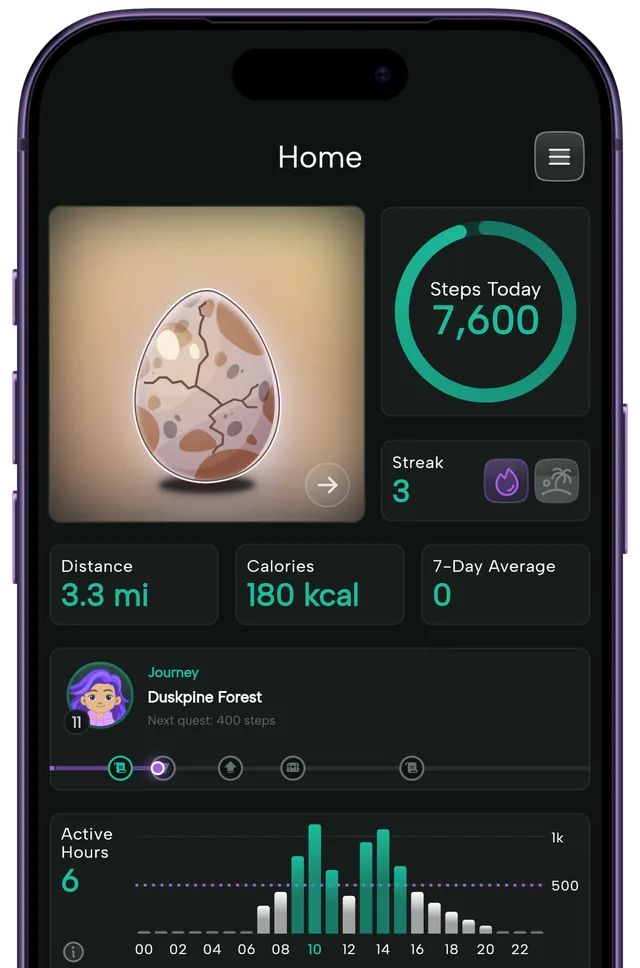
The slower pace is worth mentioning too, because it can feel like it should not "count" the way a brisk walk does. In Steps & Beasts, every step still moves your streak and your egg forward regardless of pace, so a slow, breath-synced lap around the block pulls the same weight as a fast one. The app does not know or care that you paused twice for a forward fold.
Quick answers about walking yoga
Does walking yoga count as a real workout? It counts as light to moderate cardio plus some flexibility work. It is not a replacement for strength training, but the stress reduction alone makes it worth adding to your week.
Do you need yoga experience to try it? No. The poses are optional extras, not the point. Breath-syncing and paying attention to your steps is the actual practice, and you can do that on day one.
How long should a session be? Ten to fifteen minutes is enough to notice a difference. Some guides build up to a full hour, but there is nothing wrong with keeping it short and doing it more often.