Is 10,000 Steps a Day Necessary? What Science Says
That round 10k target came from a 1960s pedometer ad, not a doctor. New research points to a lower daily range that still counts.


You open Apple Health after a long day. The ring stops at 7,842. Somewhere in the back of your mind, a voice says you failed because 10,000 is the number. I felt that too, until I learned where the benchmark came from and what newer studies actually measured.
This post is for anyone who treats 10k like a pass/fail grade. The science is kinder than the marketing, and a realistic target might get you out the door more often.
Where the 10,000-step goal really started
The familiar round number did not come from a medical trial. In the 1960s, a Japanese company called Yamasa marketed a pedometer whose name translated roughly to "10,000 steps meter." Ten thousand was catchy, easy to remember, and good for sales. Researchers including Harvard's I-Min Lee have since noted there were no studies behind that target when it was chosen.
That does not make walking useless. It just means the magic number was marketing first, science second.
What science says about your daily step count
A 2025 review in The Lancet Public Health, led by Melody Ding at the University of Sydney, pulled data from dozens of studies across more than ten countries. The pattern was consistent: most of the health gain sits below 10,000.
Walking around 7,000 steps per day was linked to a roughly 47% lower risk of early death compared with very low activity. Going from about 2,000 to 4,000 steps brought a steep drop in risk. Past 7,000, benefits for many outcomes still climb, but more slowly. NPR summarized the same takeaway in 2025: 7,000 is a realistic target for many people, and pushing to 10,000 is fine if you already get there, but not required for the core payoff.
Age and starting point matter. Some analyses show older adults get most of their benefit between 6,000 and 8,000 steps, while younger adults may see gains extend toward 8,000 to 10,000. If you sit at a desk most of the day, experts quoted in that coverage suggest you may need more movement overall to offset sedentary hours, not because 10,000 is sacred, but because inactivity is costly.
Why a smaller goal can mean more walking
Chasing an unrealistic number can make you walk less over time. Miss the target three days in a row and the app feels like a report card. Research on step programs shows people often start strong, then drift back when goals feel out of reach.
A goal you can hit on a commute-plus-lunch day builds repetition. Repetition builds habit. That is where gamified trackers help, not by adding guilt, but by giving you a finish line you can actually cross.
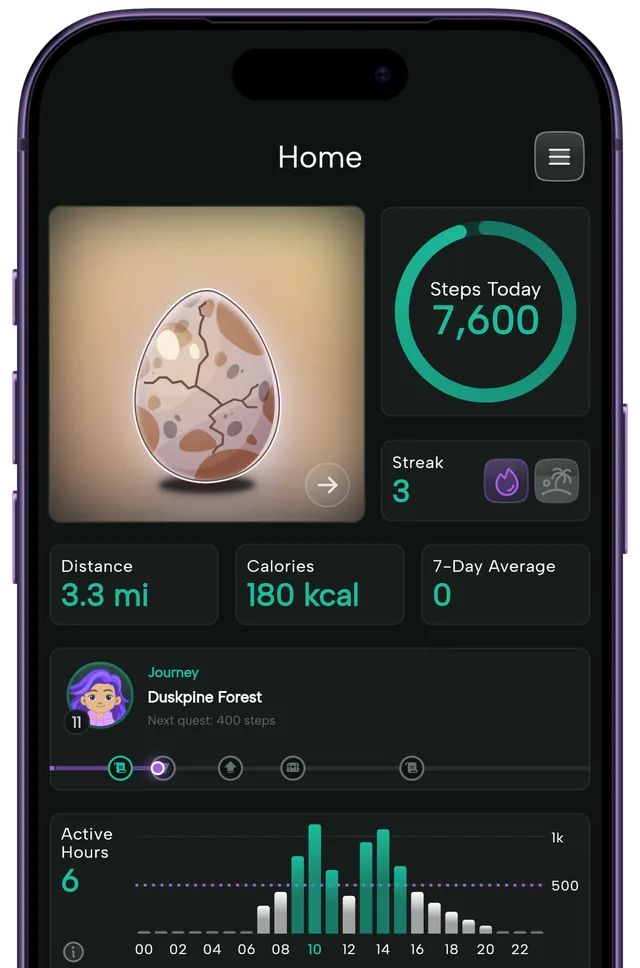
In Steps & Beasts, you receive a fresh egg each morning and hatch a Happy Beast when you hit your daily step goal. The number is yours to set. When 6,500 is a win, you stop skipping the post-dinner loop just because you are too far behind.
How to pick a step target that fits your life
- Start from a week of normal days. Check your average without trying to fix anything.
- Add 500 to 1,000 steps to that baseline, not to 10,000 because a blog told you to.
- Stack small walks: one block before coffee, stairs once, ten minutes after dinner with your phone in your pocket.
- If you hit your adjusted goal five days out of seven, bump it again.
If you love round numbers, 7,000 or 8,000 is a solid science-backed anchor. If your schedule is tight, 5,000 on busy days plus longer weekend walks still moves the needle.
Quick answers about daily step goals
Do you need 10,000 steps to lose weight? Walking helps, but weight loss depends on total activity, diet, and consistency over months. Step count is a useful proxy, not a guarantee.
Is walking 3,000 steps a day pointless? No. Studies show gains appear early when you add steps above a low baseline. Any upward shift helps.
What if you already walk 10,000 every day? Keep going. Science is not telling you to walk less. It is telling people who struggle with 10,000 that they are not failing.