Walking for Mental Health: How Steps Help Anxiety and Stress
7,500 steps a day cuts depression risk by 42%, studies find. Here's how walking eases anxiety, lifts mood, and what count actually matters.


A 2024 meta-analysis in JAMA Network Open looked at 33 studies covering more than 96,000 adults. The result was direct: people who took more than 7,500 steps per day were 42% less likely to experience symptoms of depression than those who took fewer. And the benefit started showing up at 1,000 steps above a sedentary baseline, roughly a 10-minute walk.
Those numbers deserve more attention than they get.
What the step-count studies actually found
The key finding is a dose-response curve that's steep at the low end. Moving from 2,000 to 5,000 daily steps delivers more measurable mental health benefit per step than moving from 9,000 to 12,000. A 2025 prospective cohort study, using accelerometer data across thousands of participants, confirmed the same inverse relationship for anxiety and depression.
Risk of depression fell measurably starting around 4,000 to 5,000 steps per day. The steepest part of the protection curve sits between 4,000 and 7,500. Beyond 7,500, additional steps still help, but the curve flattens. Getting from 2,000 to 5,000 matters more than getting from 8,000 to 11,000.
For anxiety, the picture is similar. Single sessions of walking reliably reduce acute anxiety within minutes. Repeated programs reduce trait anxiety over weeks. No prescription, no gym.
Why walking works on stress specifically
Rhythmic, repetitive movement calms the nervous system in ways that sedentary rest does not. Researchers describe this as downregulation of physiological arousal: the body reads the walking signal as safe and moving forward, rather than frozen and threatened.
Walking is also one of the better-studied rumination interrupters. It's hard to hold a tight thought-loop when your visual field is constantly changing and your legs have a task. Stanford research found that 90 minutes of walking in a natural or semi-natural environment measurably reduces rumination depth compared to the same time spent walking in an urban environment.
Outdoor walking also adds daylight exposure, which regulates cortisol rhythms and supports sleep. It's a lot of independent mechanisms converging on the same outcome.
You don't need 10,000 steps to feel the difference
The evidence target for mood benefits sits around 4,000 to 7,500 steps per day. If your current count is 2,000 to 3,000, you're not chasing 10,000 as a minimum. You're chasing 5,000 as a first meaningful milestone. That gap is smaller, and every 1,000 steps of progress has real effect.
A 10-minute walk is a legitimate dose. Not a consolation prize. The SimplyPsychology synthesis of current research (2026) put it this way: the first 20 minutes you add are the most valuable 20 minutes that exist. The steep part of the benefit curve rewards people at the bottom, not the top.
Building the habit when motivation is already low
Mental health and motivation have a complicated relationship. Low mood often makes starting feel impossible, yet walking is one of the things that would help. This isn't a new insight. But here's a practical frame: you're not deciding whether to walk. You're deciding whether to put on shoes.
Trigger-based habits work better here than willpower. Attach a short walk to something that already happens: after making coffee, after ending a work call, after dropping kids at school. Keep the target low enough to hit on the hardest days. Consistency is the mechanism, not heroism.
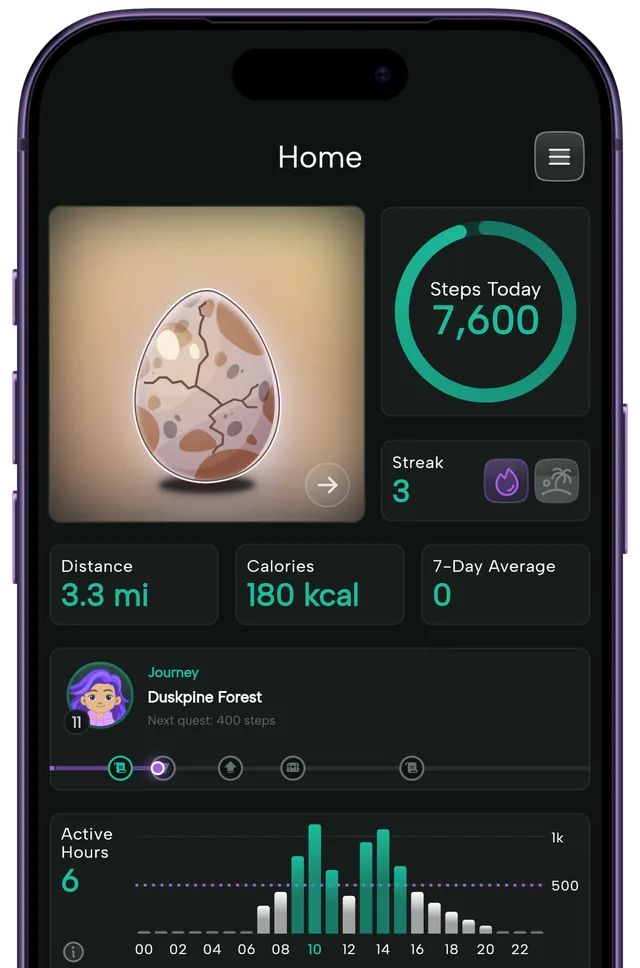
Visual feedback helps too. Seeing a streak grow, or watching a creature hatch from an egg as you close in on your daily goal, provides a concrete signal of forward movement on days when everything else feels stuck.
Starting is the whole challenge
The first walk after a rough week is harder than the first walk of a good month. Once you're outside, or in the hallway, or pacing the kitchen, the walk tends to happen. The research backs this: single sessions reliably lift mood, even when starting conditions are poor.
Steps & Beasts turns that daily step into something visible: a streak that grows, creatures that evolve, an egg that gets closer to hatching every time you move. Set a goal you can hit on a hard day and let the streak do the accumulating. Download Steps & Beasts and take the first walk.